

How to Choose a Nanny Agency in London: The Questions That Matter
Table of Contents
Toggle
By Francesco De Biase | Co-Founder and CEO, Xerendipity
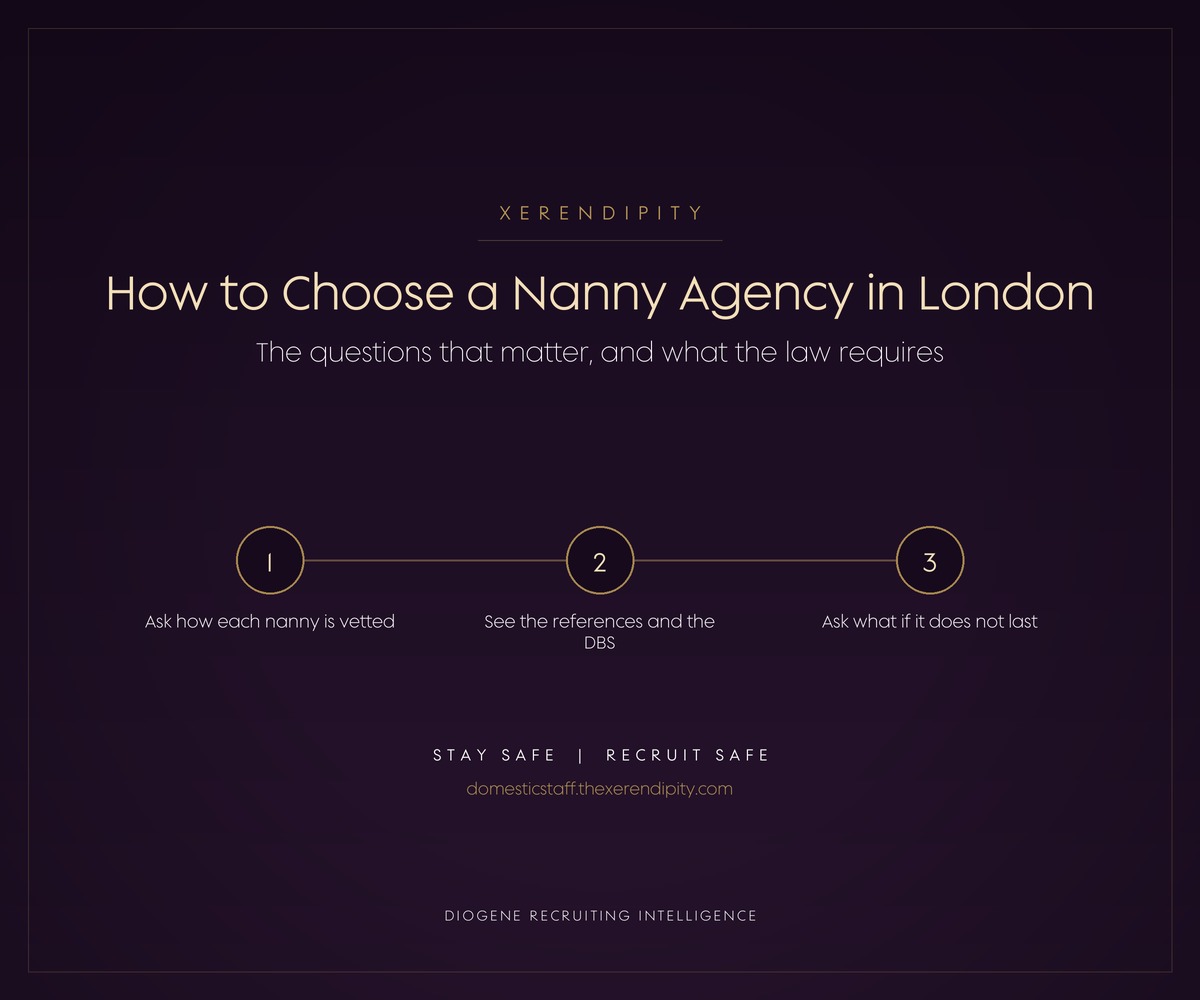
To choose a nanny agency, ask how it vets a nanny, not how many nannies it has on file. The law already requires an agency to confirm a nanny’s identity and experience and to offer you two references. The questions that matter are what it does beyond that minimum, and what happens if the placement does not last.
Last updated: November 2026
A family looking for a nanny in London will find no shortage of agencies, and very little to tell them apart on a website. Every agency says it vets its candidates. Few say how. The difference lies in what happens between the first telephone call and the day a profile reaches you — and that is where the right questions come in.
What the law requires of a nanny agency in the UK
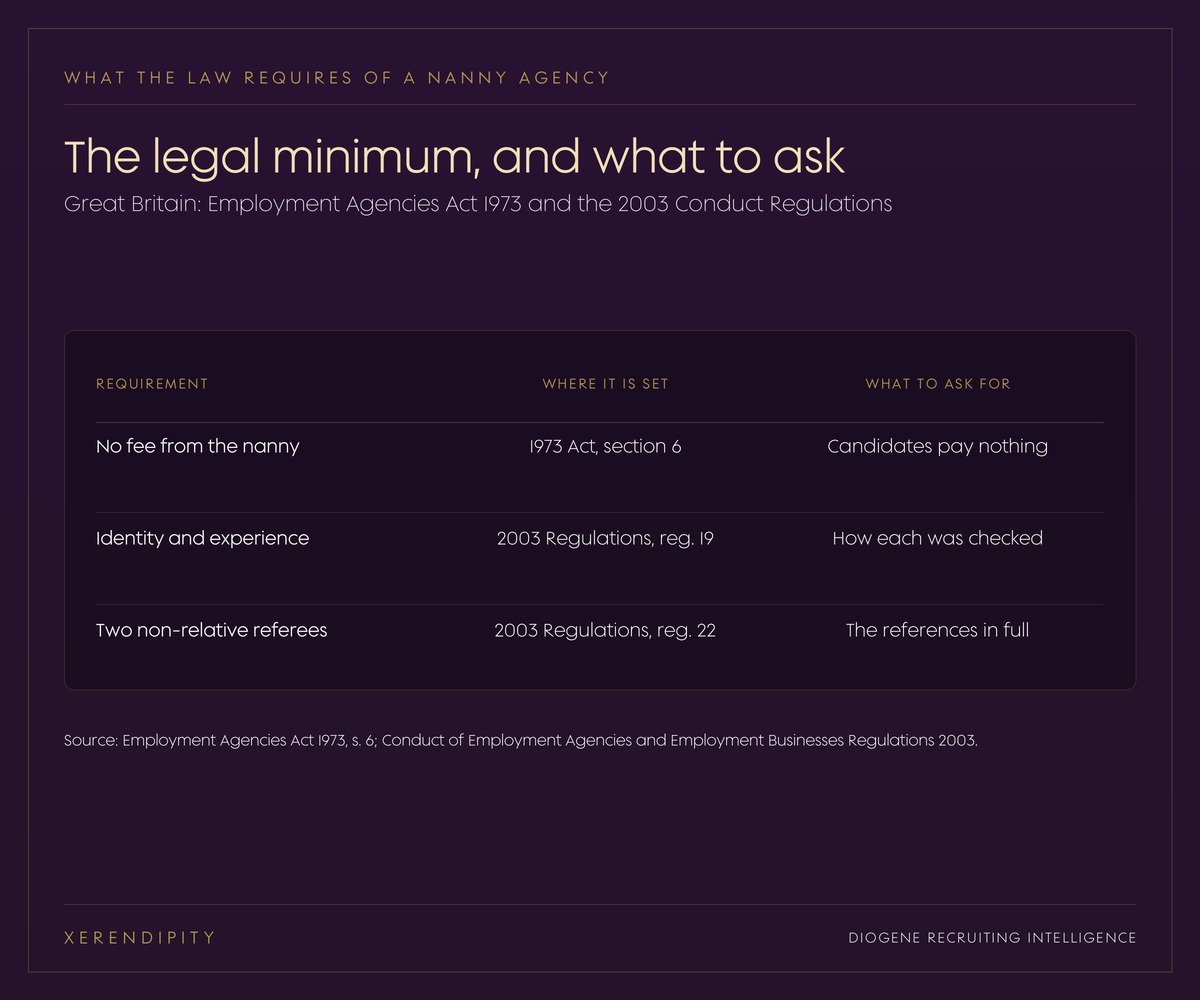
A nanny agency in Great Britain works under the Employment Agencies Act 1973 and the Conduct of Employment Agencies and Employment Businesses Regulations 2003. Knowing what a compliant agency must already do tells you what you are entitled to ask for.
The first distinction is between an employment agency and an employment business. In GOV.UK’s terms, an agency finds work for people who are then employed and paid directly by the employer: a permanent nanny, in most families’ language. An employment business engages the worker itself and supplies them to you, as with temporary cover. If an agency introduces a nanny and you hire them, you are the employer.
The rules that matter most to a family are these:
- No fee from the nanny. Section 6 of the Act prohibits an agency from charging a work-seeker for finding them work. The exceptions in Schedule 3 of the Regulations cover performers, models, professional sportspeople and some production roles, not domestic work.
- Information from you first. Under regulation 18, an agency may not introduce anyone until it knows enough about the role to select a suitable candidate: start date and duration, the work, hours and location, the qualifications required, and the pay, benefits and notice on offer.
- Checks on the nanny. Regulation 2 counts anyone under 18 as a vulnerable person. For a role caring for children, regulation 19 requires the agency to confirm the nanny’s identity and that they have the experience, training and qualifications the role needs.
- Documents offered to you. Regulation 22 requires copies of relevant qualifications and authorisations, and two references from people who are not their relatives, offered to you, together with all other reasonably practicable steps to confirm the nanny is suitable. If the agency cannot do all of this, it must tell you and explain what it tried.
- Information in writing. Under regulation 21, what the agency gives you orally when it proposes a nanny must be confirmed on paper or electronically within three business days.
One point surprises many families. The only regulation on agreeing terms with hirers concerned employment businesses, and it was removed in 2016. The terms between you and a nanny agency are a matter of contract: read them before the search begins, not after. Complaints about breaches of the Act and the Regulations now go to the Fair Work Agency, which replaced the Employment Agency Standards Inspectorate on 7 April 2026.
| What the law requires | Where it is set | What to ask the agency for |
|---|---|---|
| no fee charged to the nanny | Employment Agencies Act 1973, s. 6 | confirmation that candidates pay nothing |
| identity and experience confirmed | 2003 Regulations, reg. 19 | how each was checked, and by whom |
| two references from non-relatives | 2003 Regulations, reg. 22 | the references themselves, not a summary |
| copies of qualifications | 2003 Regulations, reg. 22 | the first aid certificate |
The checks a family should expect on a nanny
The legal minimum is a floor. A family should expect four checks as a matter of course, and should know which of them remains its own.
The enhanced DBS check. The relevant check is an enhanced Disclosure and Barring Service check with barred lists, the one Ofsted requires of registered nannies. A nanny employed directly by a family is what DBS calls a personal employee, so you cannot apply on their behalf: they apply for their own check through a DBS umbrella body. You may ask to see the original certificate and compare it with their identity documents; copies and photographs are not acceptable, and you should not keep one. If they subscribe to the DBS Update Service, you can run a free online status check with their consent. If a check shows the nanny is barred, you must not employ them.
References. Two references are the legal minimum. Two references, though, are not the same as two conversations with people who watched them care for children day after day — a letter on headed paper says less than a referee who has been asked the right questions. Ask the agency how many referees it speaks to, and whether it speaks to them at all.
The right to work. This check is yours. An employer must check that an applicant is allowed to work in the UK before employing them, from their original documents or online with a share code, and keep a copy and the date of the check for the length of their employment and two years after. Without a correct check, an employer can face a civil penalty of up to £60,000 for each illegal worker. A good agency will help you prepare; it cannot do it in your place.
First aid. Ofsted asks registered nannies for a first aid qualification suitable for the ages of the children in their care. For a baby or a young child, ask for a paediatric first aid certificate, and for the copy the agency should already hold.
Ofsted registration for a nanny is voluntary, and useful
In England, nannies do not have to register with Ofsted. They can choose to join the voluntary part of the Childcare Register. To do so, a nanny needs an enhanced DBS check with barred lists, a level 2 childcare qualification or training in the common core skills, a first aid qualification suitable for the ages of the children, and public liability insurance once they start work.
There is a practical benefit. A registered nanny counts as approved childcare for Tax-Free Childcare: for every £8 a family pays in, the government adds £2, up to £500 every three months for each child. Registration does not replace the agency’s own vetting. It shows that the nanny has met a public standard, and it can reduce the cost of employing them.
The questions that matter when choosing a nanny agency
With the law in mind, the conversation with a nanny agency in London becomes easier to direct. These are the questions we would ask in your place.
How is each candidate vetted, and by whom? An agency should be able to describe its method in a few sentences: who interviews the nanny, how often, and what is checked before a profile reaches you. At Xerendipity every nanny we present has passed three interviews and four reference checks. A vague answer here is an answer.
What will you show me? You are entitled to be offered the references and the copies of qualifications the agency has obtained. Ask to see them, and the DBS certificate when you meet the nanny.
Will you introduce the nanny, or supply them? In other words, who will be their employer? The answer decides who runs the payroll, who holds the contract, and who answers for their holiday and sick pay.
What did you ask about us? An agency that asks little about your children, your routine and the rest of the household is selecting against a description it has never taken.
What happens if the placement does not last? This is the question families most often forget, and the one they remember afterwards. Ask whether there is a guarantee, how long it lasts and what would void it. A Xerendipity placement carries an 18-month guarantee for a professional nanny and a 12-month guarantee for a babysitter or a housekeeper who also cares for the children: if the nanny leaves or proves unsuitable within that period, we select a replacement of equal standing at no further cost.
After the nanny agency: your obligations as an employer
Once you have offered the nanny the role, the relationship is yours. On their first day you must give them a written statement of the main terms of their employment. You become responsible for their income tax and National Insurance under PAYE, for employer’s National Insurance, for a workplace pension where they qualify, and for their holiday and sick pay. We set out these costs, with the 2026/27 rates and a worked example, in the cost of employing a nanny in the UK.
No agency can take these duties from you. What a good one can do is make sure the person you employ is the right one, which is, in the end, the reason to use an agency at all.
Frequently asked questions
Q: Can a nanny agency charge the nanny a fee?
A: No. Section 6 of the Employment Agencies Act 1973 prohibits an agency from charging a work-seeker for finding them work, and the exceptions in Schedule 3 of the 2003 Regulations do not include domestic work.
Q: Can I run a DBS check on my nanny myself?
A: No. A nanny employed directly by a family applies for their own enhanced check through a DBS umbrella body. You can see the original certificate and, with their consent, check its status on the Update Service if they subscribe.
Q: Does a nanny have to be registered with Ofsted?
A: No. In England the voluntary part of the Childcare Register is optional, but a registered nanny counts as approved childcare for Tax-Free Childcare.
Q: How many references should a nanny agency take?
A: For a role caring for children, the law requires two references from people who are not the nanny’s relatives. Xerendipity carries out four reference checks on every candidate, after three interviews.
Choosing an agency is choosing whose judgement you will rely on before you meet anyone. Ask the questions, read the answers, and take your time. When you would like to begin with the household rather than with a list of candidates, we will start there.
This article describes the law in Great Britain as of November 2026 and does not replace legal advice.
Further reading: Professional nanny · Recruiting a qualified nanny · The cost of employing a nanny in the UK · Housekeeper, head housekeeper or house manager · The Xerendipity warranty
Sources: Employment Agencies Act 1973, s. 6; Conduct of Employment Agencies and Employment Businesses Regulations 2003 (SI 2003/3319), regs 2, 17 (omitted 2016), 18, 19, 21, 22, 26 and Sch. 3; GOV.UK: Employment agencies and businesses; Making a complaint to the Fair Work Agency; DBS checks for self-employed people and personal employees; Private individuals employing personal employees; Check a job applicant's right to work; Penalties for employing illegal workers; Nannies: registration; Nanny: Ofsted requirements; Tax-Free Childcare; Written statement of employment particulars.
Subscribe Newsletter on LinkedIn

Francesco De Biase
STAY SAFE | RECRUIT SAFE
Contattami per Parlare delle Tue Necessità
Francesco De Biase – C.E.O.
Uff. (+39) 02 80888425
STAY SAFE | RECRUIT SAFE
Contattami per Parlare delle Tue Necessità
Francesco De Biase – C.E.O.
Email: clienti@thexerendipity.com
STAY SAFE | RECRUIT SAFE
Contattaci per Candidarti con Xerendipity
E-Mail: selezione-personale@thexerendipity.com