

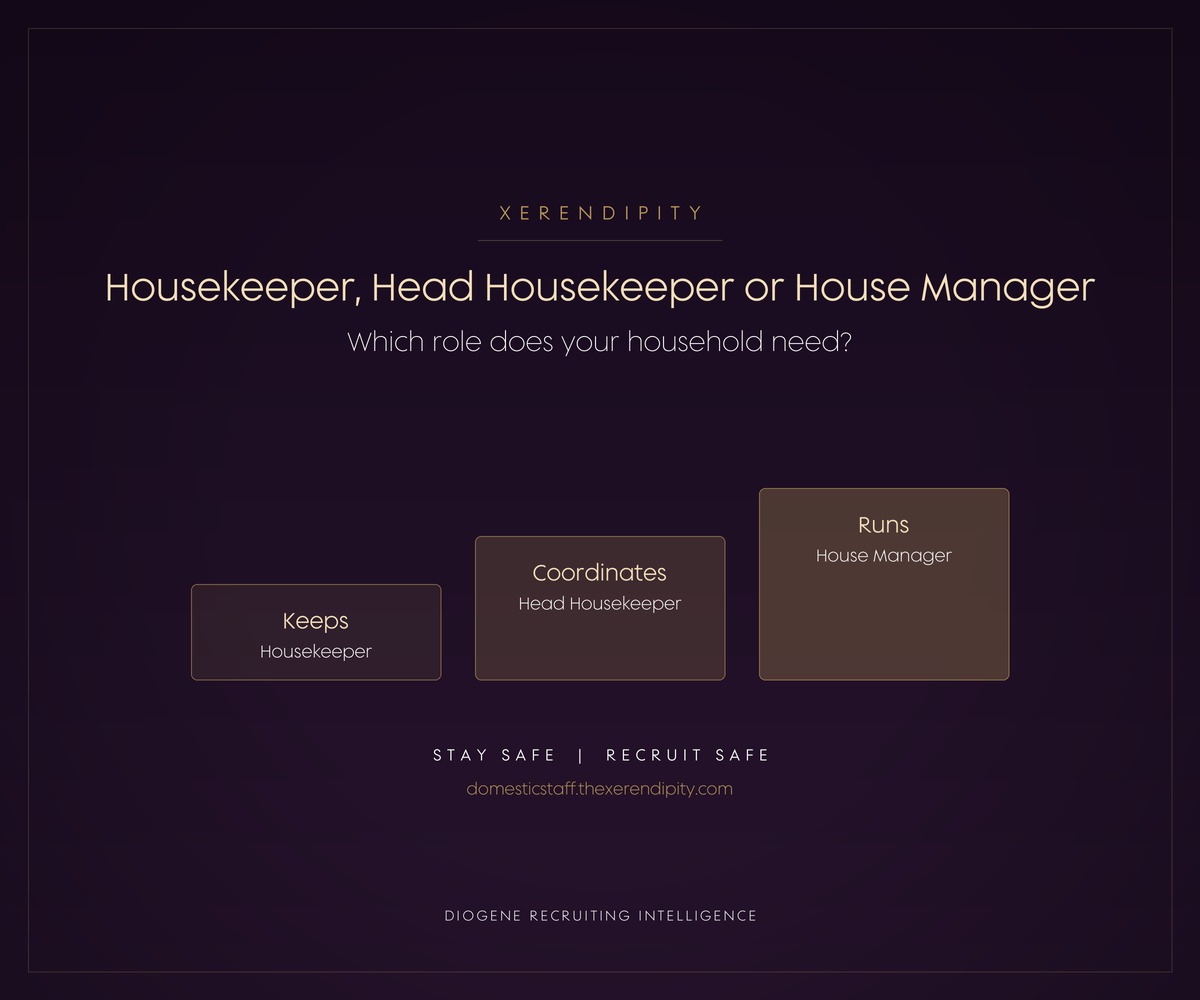
Housekeeper, Head Housekeeper or House Manager: Which Role Does Your Household Need?
Table of Contents
Toggle
By Francesco De Biase | Co-Founder and CEO, Xerendipity
A housekeeper keeps the house with her own hands. A head housekeeper coordinates the people who keep it. A house manager runs the house as an organisation: staff, suppliers, budget and diary. The right role depends less on the size of the property than on how many people already work in it, and on who coordinates them today.
Last updated: October 2026
Many families come to us asking for a head housekeeper when what they need is a highly experienced housekeeper. Others ask for a housekeeper when their household already needs someone to direct everyone else. The confusion is understandable: the three titles are often used as steps on the same ladder. They are not. They are three different professions.
The housekeeper keeps the house
A housekeeper carries out the many tasks of daily household life: cleaning and presentation, laundry and pressing, often some cooking, the care of pets. In Italy, where Xerendipity places a large share of its staff, the national contract for domestic work (renewed on 28 October 2025) calls this role a general household assistant and places it at level B: specific competence, exercised at an executive level, under the direct guidance of the family.
In a household with one member of staff, a housekeeper is almost always the right choice. An experienced housekeeper from private residences knows how to care for antique parquet, delicate fabrics and silver that must never meet the first polish to hand. But her work remains doing, not organising the work of others.
The head housekeeper coordinates the people who keep it
The head housekeeper’s role is coordination. The Italian contract places the governante at level D, reserved for positions “characterised by responsibility, decision-making autonomy and/or coordination”, and defines her work as coordinating the room service, pressing, laundry and wardrobe.
A head housekeeper makes sense when two or more people already work on the care of the house, or when the house is large enough to need a method: the calendar of deep cleaning, the seasonal rotation of wardrobes, the linen inventory, the preparation of rooms for guests. She may well work with her own hands, and often does. But she answers for the result.
The house manager runs the house as an organisation
The house manager, whom the Italian contract calls the “director of the household” and places at its highest level, D Super, manages and coordinates everything connected with the running of the house. Not only the care of the rooms, therefore, but all that makes a residence work: the staff (housekeepers, head housekeeper, chef, chauffeur, gardener), suppliers and maintenance, the household budget, security, and the family’s diary when the house is receiving.
In families with several residences, or with one residence that operates like a small enterprise, the house manager is the principal’s single point of reference. Appointing a house manager is not buying hours of work. It is delegating a function.
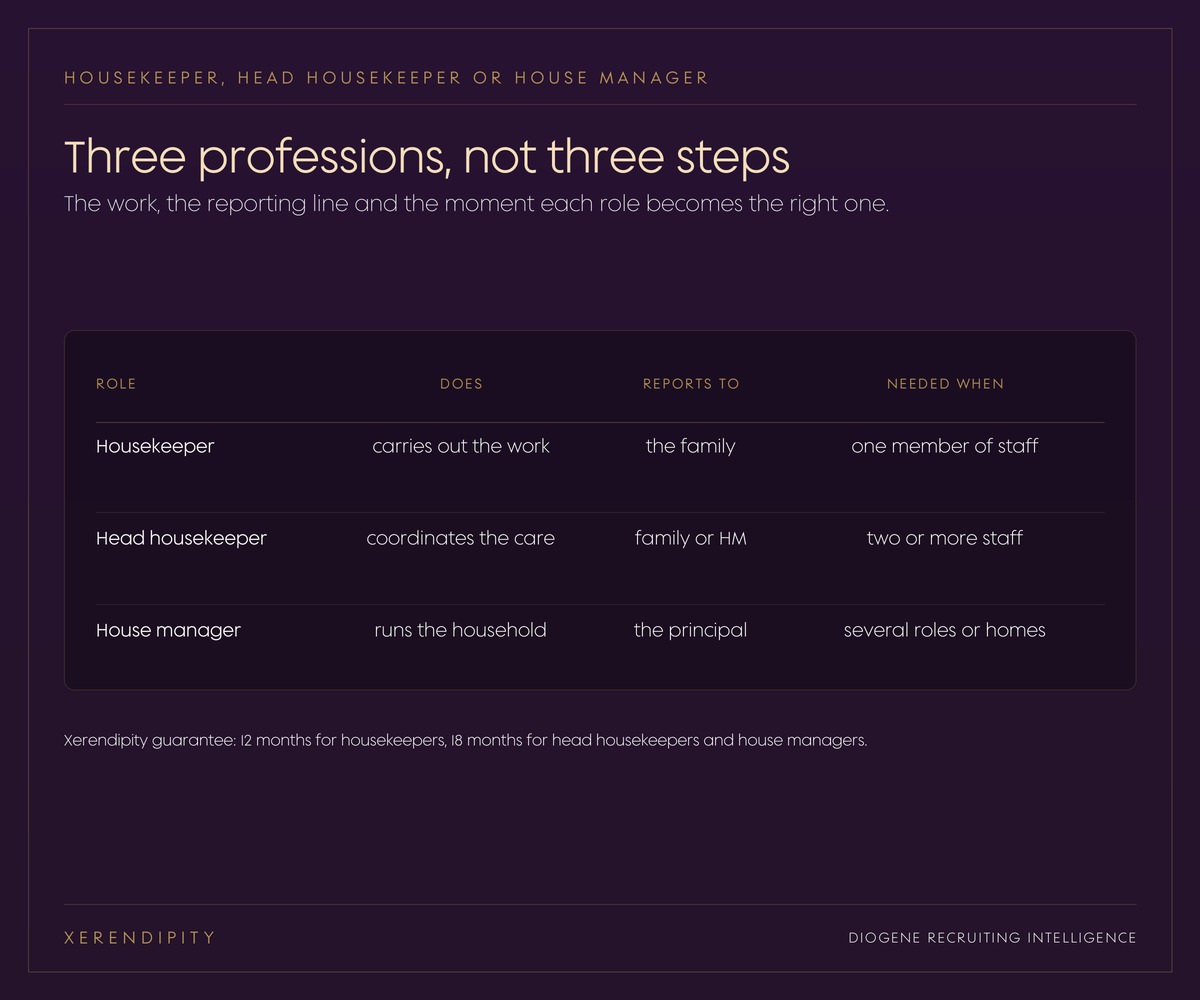
The three roles side by side
| Housekeeper | Head housekeeper | House manager | |
|---|---|---|---|
| What the role does | carries out: cleaning, presentation, laundry, often cooking | coordinates rooms, pressing, laundry, wardrobe | runs the whole house: staff, suppliers, budget, diary |
| Reports to | the family | the family, or the house manager | the principal |
| When it is needed | one member of staff | two or more people caring for the house | several different roles, or several residences |
| Italian contract level (CCNL 2025) | B | D | D Super |
| Xerendipity guarantee | 12 months | 18 months | 18 months |
How to tell which role your household needs
The useful question is not how large the house is, but how many people work in it and who coordinates them today. If the answer is “one person, and I coordinate her myself”, you need a housekeeper, perhaps a very experienced one. If two or three people work on the care of the house and someone in the family spends hours each week organising them, you need a head housekeeper. If the house has different roles (someone who cooks, someone who drives, someone who tends the garden) and a family member acts as the switchboard between them, you need a house manager.
A second signal is the family’s own time. Anyone who spends evenings answering suppliers, checking invoices and rearranging rotas already has a house manager: themselves. It is the most expensive role in the house — it is paid for in the family’s time.
How the roles combine
In the largest residences the three roles live together in a clear chain: the house manager directs, the head housekeeper coordinates the care of the rooms, the housekeepers carry it out. In a town house with two members of staff the chain shortens, and a head housekeeper who also works hands-on is often enough. What does not work is ambiguity: a housekeeper asked to coordinate colleagues without the role, or a head housekeeper also expected to handle the suppliers and accounts of a second residence. In both cases the person does not lack ability. She lacks a clear remit.
What changes in selection and in the guarantee
For all three roles, every candidate we present has passed three interviews and four reference checks. What changes is the depth of the checks, because a house manager handles the family’s people and money, and the length of the Xerendipity guarantee: 12 months for housekeepers, 18 months for head housekeepers and house managers.
If you are employing in Italy, the contract also sets the trial period: 8 days of actual work at level B, or 30 if the housekeeper lives in; always 30 days at levels D and D Super.
Frequently asked questions
Q: Is a head housekeeper simply a more experienced housekeeper?
A: No. The roles are different in kind: the housekeeper carries out the work, the head housekeeper coordinates it. An experienced housekeeper remains a housekeeper until she is given responsibility for coordinating others.
Q: What is the difference between a head housekeeper and a house manager?
A: The head housekeeper coordinates the care of the house: rooms, pressing, laundry, wardrobe. The house manager runs the whole household: all the staff, the suppliers, the budget and the family’s diary.
Q: Is a housekeeper the same as a cleaner?
A: No. A cleaner usually comes for a set number of hours to clean. A housekeeper in a private household looks after the house as a whole: presentation, laundry and pressing, the care of fine materials, often meals, and the small rhythms that keep the household running.
Q: Does a single residence need a house manager?
A: Yes, when several different roles work in the house and the family does not wish to coordinate them personally. The number of people and suppliers to direct matters more than the number of residences.
Whichever the role, the starting point is the same: understanding how your house lives before looking for the person who will keep it. When you are ready, we will begin there.
Further reading: Professional housekeeper · Professional head housekeeper · Professional house manager · The Xerendipity warranty · The cost of employing a nanny in the UK
Source: Italian national collective agreement for domestic work (CCNL), 28 October 2025, articles 9 (classification) and 12 (trial period).
Subscribe Newsletter on LinkedIn

Francesco De Biase
STAY SAFE | RECRUIT SAFE
Contattami per Parlare delle Tue Necessità
Francesco De Biase – C.E.O.
Uff. (+39) 02 80888425
STAY SAFE | RECRUIT SAFE
Contattami per Parlare delle Tue Necessità
Francesco De Biase – C.E.O.
Email: clienti@thexerendipity.com
STAY SAFE | RECRUIT SAFE
Contattaci per Candidarti con Xerendipity
E-Mail: selezione-personale@thexerendipity.com