

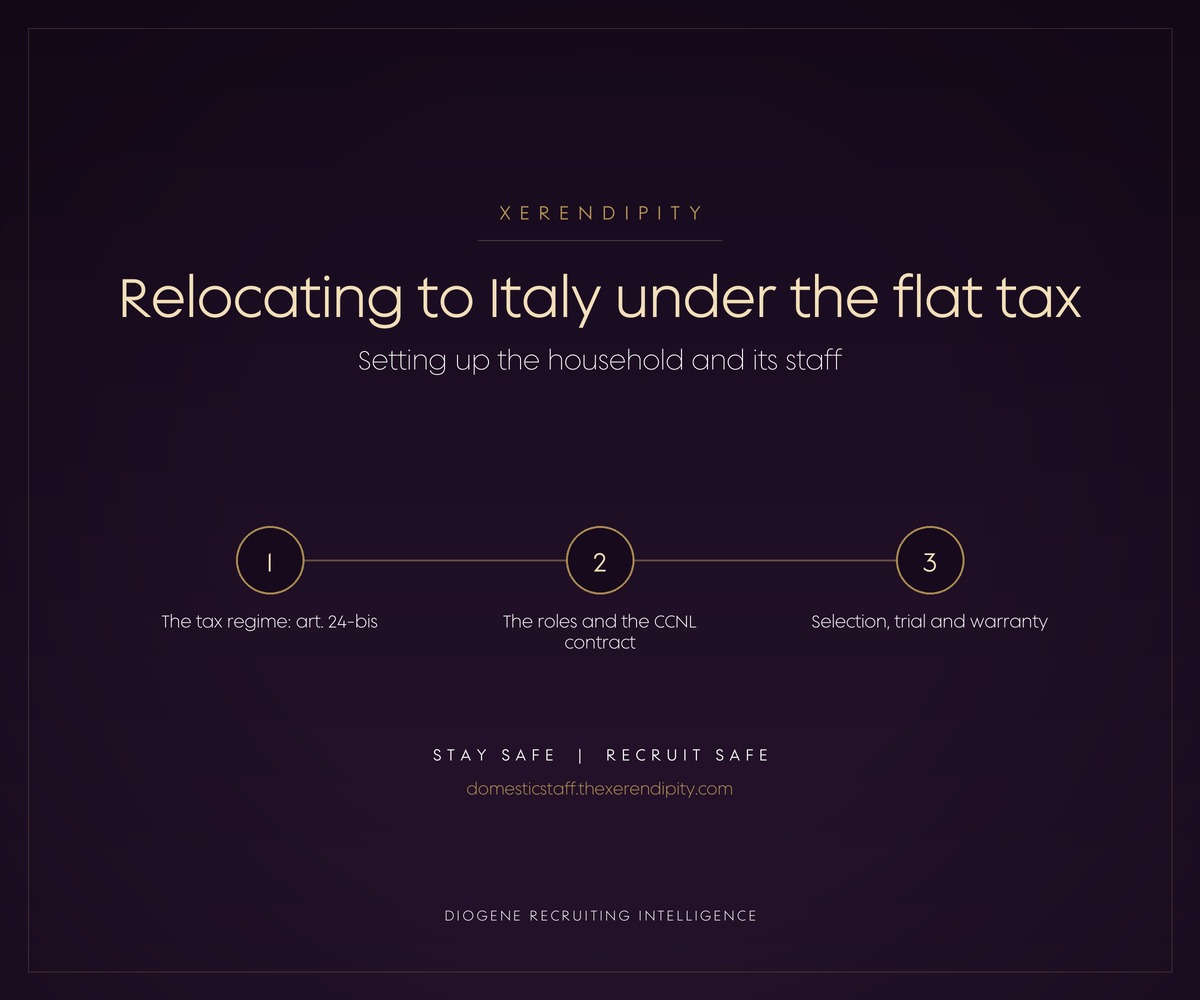
Relocating to Italy under the €300,000 Flat Tax: Setting Up the Household and Its Staff
Table of Contents
Toggle
By Francesco De Biase | Co-Founder and CEO, Xerendipity
Anyone moving their tax residence to Italy from 2026 may opt for the substitute tax in article 24-bis of the income tax code: €300,000 a year on foreign income, €50,000 per family member included, for up to fifteen years. The household follows everyone’s rules: staff employed under the national domestic work contract, INPS notification, quarterly contributions.
Last updated: November 2026
For families relocating to Italy, the tax decision almost always comes first, and rightly so: it needs an adviser, a ruling request and a precise timetable. The household comes later. Often too late — when the family is already travelling, and the person who should have opened the house was due to start the week before. Here we keep the two together.
The flat tax for those relocating to Italy: what article 24-bis provides
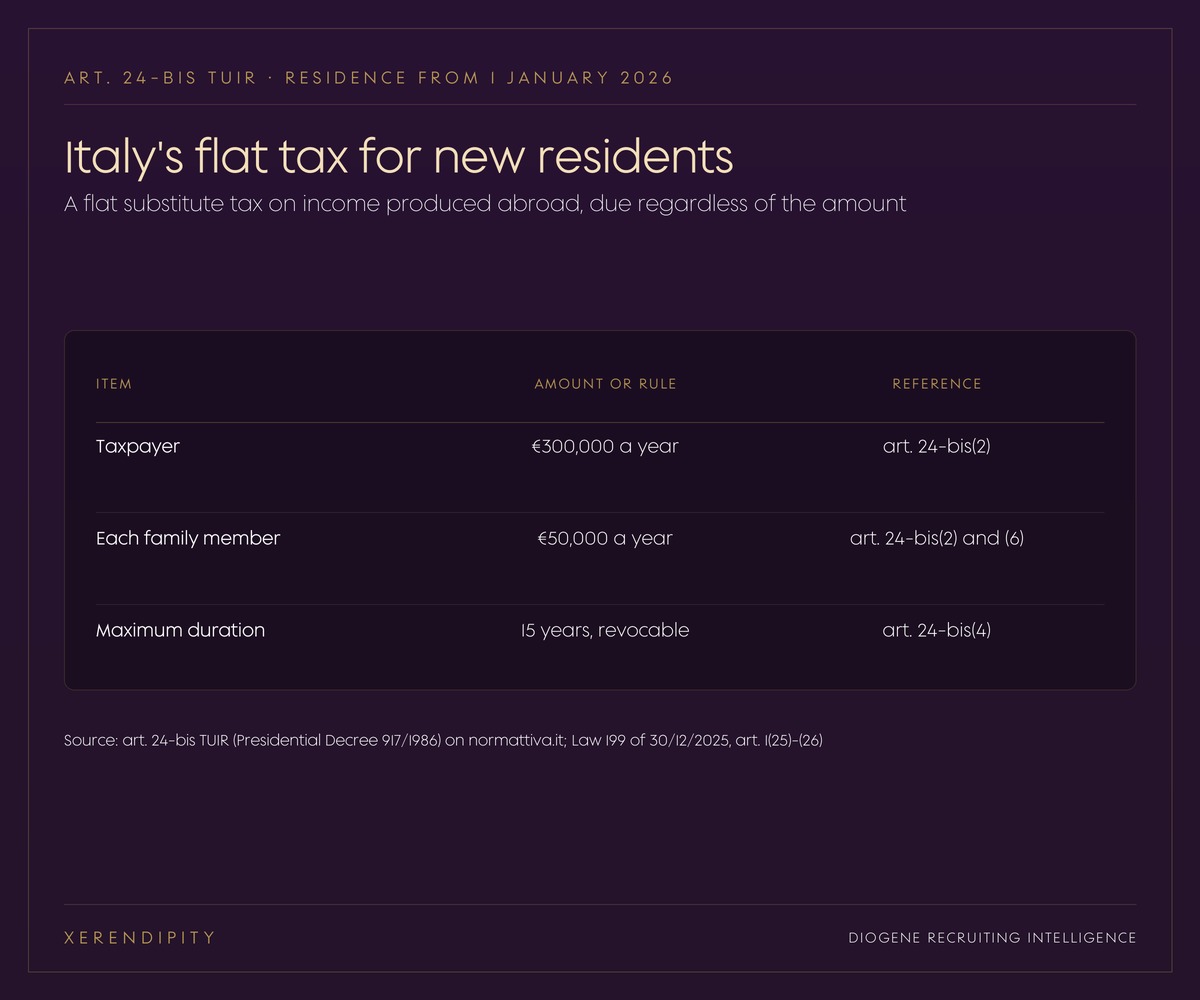
The new-resident regime is an option. Anyone who transfers their tax residence to Italy may subject income produced abroad to a flat substitute tax, due regardless of how much that income is. For those who transfer their residence from 1 January 2026, the tax is €300,000 for each year the option applies, reduced to €50,000 for each family member to whom it is extended (2026 Budget Law, Law no. 199 of 30 December 2025, article 1, paragraphs 25 and 26).
| Item | What the law provides | Reference |
|---|---|---|
| Substitute tax | €300,000 a year, on income produced abroad | art. 24-bis(2) |
| Family members | €50,000 a year for each family member included | art. 24-bis(2) and (6) |
| Who may opt | anyone not tax resident in Italy for at least nine of the ten preceding tax years | art. 24-bis(1) |
| How to opt | after a favourable reply to a ruling request (interpello) to the Italian Revenue Agency, by the deadline for the tax return for the year of the move | art. 24-bis(3) |
| Duration | revocable; ends in any case after fifteen years; lapses if the tax is not paid | art. 24-bis(4) |
| Payment | in a single instalment, by the deadline for the income tax balance | art. 24-bis(2) |
| Excluded countries | income from one or more foreign states may be left under the ordinary rules | art. 24-bis(5) |
A few details matter. The substitute tax covers only income produced abroad, and does not apply to gains on the disposal of qualifying shareholdings realised in the first five years of the option. The family members who may be included are those listed in article 433 of the Italian Civil Code: spouse, children and descendants, parents and ascendants, sons- and daughters-in-law, parents-in-law, brothers and sisters, provided they too meet the nine-years-in-ten condition. For the years of the option, Law no. 232 of 2016 (article 1, paragraph 153) also exempts the taxpayer from the RW foreign-asset reporting and from IVIE and IVAFE, the taxes on property and financial assets held abroad.
Each increase applies only to those who move after it came into force: €100,000 originally, €200,000 for those who transferred their residence after 10 August 2024 (Decree-Law no. 113 of 9 August 2024, article 2), €300,000 from 1 January 2026. The family-member amount stayed at €25,000 until the 2026 Budget Law. From 1 January 2027 the same rules move to article 246 of the new consolidated income tax code (Legislative Decree no. 117 of 19 June 2026), with the same amounts.
This is a summary of the law, not tax advice: whether the regime suits you, the ruling request and the figures belong to your adviser.
Relocating to Italy under the flat tax does not change the rules for household staff
The substitute tax concerns the family’s foreign income. It does not touch the relationship with the people who work in your Italian home. From the day you employ a housekeeper, a head housekeeper or a house manager, the family is a domestic employer like any other, and applies the Italian national collective agreement for domestic work of 28 October 2025, which runs until 31 October 2028.
There are three steps: a written letter of employment, signed and exchanged by both parties (art. 6); notification to INPS, the Italian social security institute, online only, by midnight on the day before the employment begins; and contributions paid every quarter. The notification is required during the trial period too. The letter of employment is your household’s first Italian document: it deserves the same care as the ruling request.
Choosing household staff roles before the move
The first question is not who, but which role. The Italian contract distinguishes different professions: the housekeeper at level B, the head housekeeper at level D, the house manager, the “director of the household”, at level D Super (art. 9). We explain how to choose between the three in “Housekeeper, Head Housekeeper or House Manager“.
For a family arriving from abroad there is one further consideration. In the first months nobody in the house knows the suppliers, craftsmen or offices. The first person to look for is therefore often not the one who will work the most hours, but the one who can set the house in motion: utilities, maintenance, suppliers, diary. That is the remit of a house manager. Where there is one residence and one or two members of staff, a head housekeeper who also works hands-on may be enough.
Live-In or Live-Out: hours and accommodation for resident staff
The choice between Live-In and Live-Out should be made before choosing the house, not after. The contract sets different limits (art. 14): staff who live in work at most 10 hours a day, not consecutively, and 54 a week, with a weekly rest of 36 hours, 24 on Sunday and 12 on another day (art. 13); staff who live out work at most 8 hours a day and 40 a week. For a housekeeper who lives in, the trial period rises from 8 to 30 days of actual work (art. 12).
For resident staff the family must provide accommodation suitable to safeguard their dignity and privacy, and healthy, sufficient meals (art. 36); the letter of employment also states where the person may keep their personal belongings (art. 6). Anyone choosing a house in Italy with Live-In staff in mind should read the floor plan through the eyes of the person who will live there: a proper room, with windows, not a space meant for something else.
One article is read closely by families with several residences. Resident staff, if asked, follow the family on temporary stays in another municipality or at secondary residences, with travel expenses reimbursed and a daily allowance of 20% of the minimum daily wage, unless the obligation is already written into the letter of employment (art. 33). A permanent transfer to another municipality, by contrast, requires at least 15 days’ written notice (art. 32). Better to write it all down at the start.
Household staff who follow the family to Italy
Some families wish to bring with them the people who already work for them. This should be set up with an employment adviser before departure. If the person does not already have the right to work in Italy, entry goes through the decreto flussi procedure: an application for work clearance (nulla osta) within the windows of the annual decree, signature of the contract at the immigration desk (Sportello Unico), the entry visa and, within eight days of arrival, the application for a residence permit. The family documents its income and requests a certificate that the accommodation is suitable. These timescales do not depend on the family: they belong in the same calendar as the move.
Realistic timescales for selecting household staff in Italy
We do not quote a standard length for a search, because there is none: it depends on the role, the city and whether the person lives in. There is, however, a sequence. First the description of the role, written with the family. Then the search, with three interviews and four reference checks for every candidate before a profile reaches the family. Then the meeting, the letter, the INPS notification and the trial period: 8 or 30 days of actual work, depending on level and residence.
The most useful advice is also the simplest: begin once you know the address. A Live-Out role depends on the journey, a Live-In role on the room that awaits it, and neither can be judged on a house still to be chosen. The tax calendar and the household calendar are best started together.
The warranty on household staff in Italy: 12 and 18 months
Every Xerendipity placement is covered by the warranty, which has two lengths. 12 months for housekeepers and domestic assistants, housekeepers with nanny or babysitting duties, domestic couples and babysitters. 18 months for house managers, butlers, private head housekeepers, private chefs, health & performance chefs, professional nannies, chauffeurs, security staff, personal assistants, and executive personal assistants. The work of someone who runs a house is judged over a longer arc: the first winter and the first summer in Italy are different tests.
Frequently asked questions
Q: How much is the flat tax for those relocating to Italy in 2026?
A: €300,000 for each year the option applies, on income produced abroad, plus €50,000 for each family member included. The amounts apply to those who transfer their residence from 1 January 2026 (Law 199/2025, article 1, paragraphs 25 and 26).
Q: How long does the new-resident regime last?
A: At most fifteen years from the first year of the option. The option is revocable and lapses if the tax is not paid; after revocation or lapse, a new option cannot be made (art. 24-bis(4)).
Q: Does the flat tax change anything in the relationship with household staff?
A: No. The relationship with the people who work in your Italian home follows the national domestic work contract and the INPS rules, as for any family.
Q: Must Live-In staff follow the family to other residences?
A: If asked, yes, for temporary stays in another municipality or at secondary residences, with travel reimbursed and a daily allowance of 20%, unless the obligation is already written into the letter of employment (art. 33 of the CCNL).
A house in a new country is prepared the way a tax residence is: in good time, with the papers in order. With one difference — here the papers are about people. When you have the address, we will begin there.
This article describes the rules in force in November 2026. It is not tax or employment advice: for your own situation, your adviser remains the reference.
Further reading: Professional house manager · Housekeeper, Head Housekeeper or House Manager: Which Role Does Your Household Need? · Professional head housekeeper · The Xerendipity warranty
Sources: Presidential Decree no. 917 of 22 December 1986 (Italian income tax code, TUIR), article 24-bis, text in force on normattiva.it; Law no. 199 of 30 December 2025 (2026 Budget Law), article 1, paragraphs 25 and 26; Decree-Law no. 113 of 9 August 2024, article 2; Law no. 232 of 11 December 2016, article 1, paragraph 153; Legislative Decree no. 117 of 19 June 2026 (consolidated income tax code), articles 246 and 377; Italian Civil Code, article 433; Italian national collective agreement for domestic work (CCNL), 28 October 2025, articles 6, 9, 12, 13, 14, 32, 33, and 36, text published by DOMINA, a signatory; INPS, guidance pages "Formalizzare l'assunzione di un lavoratore domestico" and "Cosa fare prima dell'assunzione di un lavoratore domestico".
Subscribe Newsletter on LinkedIn

Francesco De Biase
STAY SAFE | RECRUIT SAFE
Contattami per Parlare delle Tue Necessità
Francesco De Biase – C.E.O.
Uff. (+39) 02 80888425
STAY SAFE | RECRUIT SAFE
Contattami per Parlare delle Tue Necessità
Francesco De Biase – C.E.O.
Email: clienti@thexerendipity.com
STAY SAFE | RECRUIT SAFE
Contattaci per Candidarti con Xerendipity
E-Mail: selezione-personale@thexerendipity.com